I Want to Eat Fish. I Cannot Eat Electricity: Public Participation in Mekong Basin Development
NEW BOOKS
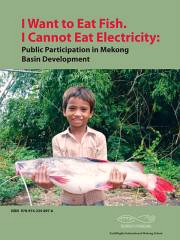 Large scale infrastructure projects throughout the world typically discourage public input in the development process. EarthRights International’s field schools in Burma, the Mekong, and the Amazon train citizens to challenge this norm.
I Want to Eat Fish. I Cannot Eat Electricity, features writings from EarthRights Mekong School graduates that take an in-depth look at how citizens are advocating for more equitable development in the Mekong region.
EarthRights International’s Mekong School is a training program for civil society advocates from the Mekong Region (Yunnan/China, Burma, Laos, Thailand, Cambodia, and Vietnam) focusing on human rights and the environment.
The authors whose work is featured in this book represent a wide range of communities along the Mekong, from its origins on the Tibetan plateau to the Mekong Delta, where the river completes its 4,350 km journey and flows into the South China Sea. Mekong School alumni speak a cumulative total of twenty-three regional languages and are committed to protecting the people and environment in the Mekong region.
The papers presented in the book examine the consequences of large-scale infrastructure projects such as dams, airports, roads, irrigation projects, and hydroelectric facilities and reveal a dramatically different perspective than that of the international financial institutions.
In the first section, authors investigate community complaints regarding negative impacts from Asian Development Bank and World Bank funded projects, and make recommendations to strengthen international financial institution policies that safeguard the public.
The second chapter examines the threats posed by the series of hydropower dams currently planned and under construction along the mainstream of the Mekong to migratory fish stocks, local livelihoods, and regional food security.
The final chapter is a survey of problems related to resettlement in the wake of large dams, with a look at how civil society groups are advocating for policy reform.
EarthRights hopes that the book will inspire further work towards greater public participation and transparency in development planning in the Mekong region.
Featuring EarthRights, a grantee of the Conservation, Food, and Health Foundation


