Wrestling with Moses and Jacobs
BOOK REVIEW
By Phil Hall
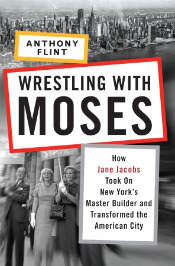 Summary: Most philanthropy in the United States is dedicated to life in cities. Similarly, the iconic urbanists Jane Jacobs and Robert Moses are best remembered for their contributions to cities. Their struggle between grand plans to transform cities versus a more organic and democratic process that prizes citizen involvement continues to this day. Phil Hall explores what funders can learn from these two extraordinary people.
Wrestling with Moses: How Jane Jacobs Took on New York’s Master Builder and Transformed the American City
By Anthony Flint
Random House, 2009, 199 pages
The Power Broker: Robert Moses and the Fall of New York
By Robert Caro
Random House, 1974, 1,166 pages
The Death and Life of Greater American Cities
By Jane Jacobs
Modern Library, 1961, 585 pages
I. Two Cities
Here is one way of looking at a city:
One Sunday in 1914, Robert Moses was crossing the Hudson by ferry to picnic in New Jersey. With him were some college friends and their dates, one of whom was Frances Perkins, later to be United States Secretary of Labor. As the ferry pulled out into the river, Moses leaned on the rail, watching Manhattan Spread out beside him and suddenly she heard Moses exclaim, “Isn’t this a temptation to you? Couldn’t this waterfront be the most beautiful thing in the world?” As the woman looked to him in astonishment, words began to pour out of Bob Moses and she realized that “he had it all figured out. How you could build a great highway that went uptown along the water. How you’d have to tear down a few buildings at Seventy-second Street and bring the highway around a curve….He wanted places were people could leave their boats safely, public clubs…like private clubs.” Staring back at the bleak mud flats covered by a haze of smoke from the railroad engines, she heard Moses paint for her a picture of what the scene could be like on a Sunday—the ugly tracks completely hidden by the great highway, cars traveling slowly along it, their occupants enjoying the view, and along the highway stretching green parks filled with strollers, tennis players and families on bicycles. There would be sailboats on the river and motor yachts tied up in gracefully curving basins. And the thing that astonished her most, Miss Perkins was to recall, was that Bob Moses had the exact location of tennis courts and boat basins quite definitely in mind; the young Bureau staffer beside her was talking about a public improvement on a scale almost without precedent in turn- of-the-century Urban America, an improvement that would solve a problem that had baffled successive city administrations for years. And “he had it all figured out.”
And here is another:
Under the seeming disorder of the old city, wherever the old city is working successfully, is a marvelous order for maintaining the safety of the streets and the freedom of the city. It is a complex order. Its essence is intricacy of sidewalk use, bringing with it a constant succession of eyes. This order is all composed of movement and change, and although it is life, not art, we may fancifully call it the art form of the city and liken it to a dance—not to a simple-minded precision dance with everyone kicking up at the same time, twirling in unison and bowing off en masse, but to an intricate ballet in which the individual dances and ensembles all have distinctive parts which miraculously reinforce each other and compose an orderly whole. The ballet of the good city sidewalk never repeats itself from place to place, and in any one place is always replete with new improvisations.
As it happens, these diametrically opposed viewpoints have come to dominate the world of urban planning. Following his ferry ride, Robert Moses went on to become the most significant city builder in the history of the United States. In her view of cities as living ecosystems functioning with a complex logic of their own, Jane Jacobs has had the more lasting legacy, at least in the minds of present-day urban planners. Robert Caro’s The Power Broker, Jacobs’ own Death and Life of Great American Cities and, now, Wrestling with Moses by Anthony Flint, provide a glimpse of what made these two opposites tick and, by extension, how great cities are made.
II. Robert Moses
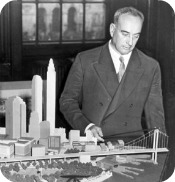 By any measure, the list of Robert Moses’s accomplishments is staggering. In addition to vastly expanding New York state’s park system, he developed six expressways and hydroelectric power projects on the Niagara and St. Lawrence Rivers. In the five boroughs, he is responsible for 13 expressways, seven bridges, 658 playgrounds, and, though he was not directly associated with the New York City Housing Authority, he had the final word for the construction of 1,082 buildings of affordable housing between 1945 and 1958. This is not to mention the creation of Lincoln Center, the Center City Coloseum, the United Nations and Shea Stadium. To put the Moses story into financial perspective, between 1949 and 1957 the (now disparaged) federal urban renewal program expended $133 billion dollars (in 1968 dollars) on all cities other than New York. Thanks to Moses, New York alone received $267 billion ($1.6 trillion in 2009 dollars) or more than double that amount during the same time period.
As a necessary consequence of all this building, Moses was responsible for the displacement of hundreds of thousands of individuals, most notably and cruelly through the development of the Cross-Bronx Expressway. “When you operate in an overbuilt metropolis, you have to hack your way with a meat ax,” is, thanks to Caro, his most memorable quote and has come to symbolize the excess of a top-down, now largely discredited approach to city development.
The son of a wealthy family with a tradition of noblesse oblige, Moses dedicated his life to public service. His first incarnation, as a planner for the New York Bureau of Municipal Research, where he was intent upon reforming the corrupt system of patronage of Tammany Hall, was a failure. But by allying himself with Al Smith, the four-time governor of New York, Moses began a swift ascent. He made his first mark in the creation of Jones Beach Park on Long Island, using eminent domain for highway linkage to the beach, in effect opening up Long Island to suburban sprawl. From there, his construction efforts continued unabated through the early 1960s until his loss of power in the Lindsay administration.
At his peak, Moses assumed unchallenged control of New York’s state and city development. Affectionately dubbed by Smith “the best bill writer in Albany,” he was masterful at burying the terms of his control in long legislative bills, ensuring the terms of his leadership would outlast those of the mayors and governors he served. Another secret was to move quickly, keeping one step ahead of bureaucracy. Moses was always prepared with shovel-ready projects and was the recipient of more New Deal money for his projects than the rest of the city government itself. His projects were highly visible and became politically indispensible to mayors, governors and even President Franklin D. Roosevelt, who attempted unsuccessfully to remove Moses from power. Here is a description, contrasting sharply with the stimulus investments of our own recessionary time, of the Moses restoration of Central Park in 1934, during one of the coldest winters in the history of the city.
At dusk, thousands of men filed into Central Park to replace those who had been working during the day, and when the watchers in the apartment houses retired for the night—for nights that they complained were made restless by the noise—they could take a last look out their windows and see the pickaxes still swinging in the harsh glare of hundreds of high-powered carbide lamps. When they awoke in the morning, the pickaxes were still swinging—and they realized that a third shift had filed into the park during the night. The work was going on twenty-four hours a day.
As a final ingredient of power, Moses became a master of the public authority, which he learned, in Caro’s words, “possessed not only the powers of a large corporation but some of the powers of a sovereign state,” including powers of eminent domain and a small board size. Moses was the sole member of the Henry Hudson Parkway Authority, and he held ironclad control over his most valuable asset, the Triborough Bridge and Tunnel Authority. Until Moses, Caro notes, public authorities in America were intended primarily for limited projects such as a bridge or highway and shut down as soon as they fullfiled their debt obligation. Moses kept them going to generate surpluses which in turn floated bonds for financing of new Moses-controlled projects. In 1938, for example, the Triborough Bridge Authority registered a $4.5 million surplus from commuter tolls, which was used to leverage $81 million in bond revenues for new development.
Moses faced no meaningful opposition until Nelson Rockefeller assumed the governership in 1959. A series of missteps finally resulted in his downfall, including an expose of misuse of public housing dollars by Moses-supported banks and developers, an embarassing run-in with Joseph Papp and his Public Theater, and disappointing performance as president of the 1964 World’s Fair. Apart from these incidents, the city and state were turning from a Moses outlook, where large projects were linked by highways leading to gridlock and suburban sprawl, to a Jacobs outlook, where the integrity of old cities was beginning to be valued, and emphasis was changed from orderly “renewal” to preservation of the very slums Moses fought to eradicate. The Moses cycle had run its course.
III. Jane Jacobs
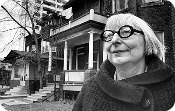 Born in Scranton Pennsylvania, Jane Jacobs moved to New York In 1934, where she was promptly smitten with the city, in particular Greenwich Village. As a schoolgirl, Jacobs exhibited decidedly nonconformist tendencies. Starting out in New York, she pursued an eclectic education while working a day job as a secretary. She enrolled in courses at Columbia’s School of General Studies but never received a degree, due largely to her poor high school record. Jacobs did become a successful freelance journalist, culminating in work for the Architectural Forum. She received her big break in 1956 when she delivered a speech at a conference on urban design at Harvard. The speech, “Downtown is for People,” was the beginning of a decade-long fight against the accepted wisdom of contemporary urban planning. Her 1961 book, The Death and Life of Great American Cities, with Rachel Carson’s Silent Spring and Ralph Nader’s Unsafe at Any Speed, helped to change the American mindset and within a decade became the new gospel for urban design.
Anthony Flint writes the biography of Jacobs the urban pioneer of 555 Hudson Street in Greenwich Village, which involved her leadership in resident-led battles against massive highway construction and urban renewal plans developed by Robert Moses. These included the proposed creation of “Park Avenue South” running through the middle of Washington Square Park and requiring the demolition of 130 buildings and displacement of 150 families to make way for “Washington Park Village,” and the “Lower Manhattan Expressway” (Lomex), allowing for speedy transit between the Hudson and East rivers. That these projects never materialized was thanks in large part to effective community organizing, including the formation of citizen groups, public advocacy and colorful protests. Robert Caro’s book, which was reduced at the urging of his publisher from a 3,000 page manuscript to a more manageable 1,100 pages, contains no mention of Jacobs (a draft chapter was eliminated), making Wrestling with Moses a welcome addition. Students of New York history will enjoy a choice photo of the young folkie Ed Koch (an early Jacobs ally) strumming his guitar in Washington Square Park.
The Death and Life of Great American Cities proposes new rules for cities, which Jacobs argues, are best appreciated by “foot people” rather than “car people.” She is devoted to sidewalks and in three chapters details their multiple benefits: as public spaces encouraging safety, as sources for human contact and as a means for assimilating children. Densely populated neighborhoods are essential, as is building and retail diversity. The term mixed-use, now a cliché of urban planning, probably stems from Jacobs’ chapter “The Need for Mixed Primacy Uses.” City blocks must be small, allowing many opportunities for turning corners, and old buildings, such as the cast iron buildings of the Tribeca neighborhood she helped to save, are essential. Unlike Robert Moses, she is generally skeptical of parks and green spaces. “Border vacuums,” large swaths of urban open space, are to be avoided at all cost.
From a vantage point of almost half a century, The Death and Life of American Cities casts an interesting light on Boston, which Jacobs had studied in some detail. She is utterly taken with the city’s North End, then classified as a slum and, astonishingly to the present-day mindset, slated for urban renewal like the then demolished West End. Jacobs notes approvingly that the neighborhood had a dwelling density nine times greater than Roxbury’s. She argues in the face of the conventional wisdom of the time that this density contributed to the North End’s lower rates of delinquency, disease and infant mortality than the city as a whole. While the North End had experienced high rates of foreclosure during the Depression and was effectively shut off from conventional lending sources, she comments on the self reliance of families who pooled resources to buy back and restore neighborhood properties.
As a proponent for mixed-use neighborhoods, she is witheringly critical of Boston zoning, including its arts district on Huntington Avenue as established in 1859 by a Committee of Institutions dedicated to Cultural Conservation. “One thing is sure: Boston’s downtown has suffered miserably from lack of good mixtures in its primary uses, particularly good mixing in of live (not museum-piece and once-upon-a-time) cultural uses.” Segregated zoning for business districts like Wall Street once again bring Boston into her line of fire:
Striking evidences of this disastrous sorting-out can be seen in many city downtowns. The successive historical centers of Boston’s downtown, like so many archeological layers, are fossilized as stratum after stratum of sorted-out uses, each stratum lacking primary mixtures, each stratum stagnated. The Boston Planning Board, analyzing downtown uses, mapped them by color – one color to designate managerial and financial offices, another for government, another for shopping, another for entertainment, and so on. The stagnant areas all show on the map as a series of virtually solid swatches of single color each. On the other hand, at the one end of the downtown area, where the Back Bay meets a corner of the Public Gardens, is a swatch of map marked with a different kind of legend, designated in red and yellow stripes. This swatch was too complex to map according to specific uses, so it was given an appropriate representational legend, standing for “mixed.” This is the only part of Boston’s downtown that is at present spontaneously changing, growing, acting like a live city.
IV. Wrestling with Moses and Jacobs
Aesthetics
Most philanthropy in the United States is dedicated to urban life, just as Jacobs and Moses are best remembered for their contributions to cities. What, if anything, can funders learn from these two extraordinary people?
Imagine six blind people trying to describe the elephant of a city in 1938. It is likely that at least five of those people would describe it in terms favorable to Moses. If the exercise were fast-forwarded to the present day, the situation would reverse, with Jacobs winning by at least 5-1. But cities are complicated, and this paradigm shift is not the whole story. For starters, Moses and Jacobs operated largely in a primarily aesthetic realm. Ironically, they often seem less concerned with the lives of city residents than such pure artists and authorities on urban life as Dickens or Dostoyevsky. Most funders, in contrast, think of cities in terms of people and make grants dedicated to improving the lives of the disadvantaged, through housing, basic services, job training, education and the like.
Jacobs is quick to notice the arty strain in Moses, who she felt to be in the thrall of the great Le Corbusier. Le Corbusier’s aesthetic of a Radiant City, consisting of concentrated residential skyscrapers within a vacant setting, as in the trademark public housing of urban renewal, is for her a nightmare:
Suppose we are entering the city by way of the Great Park. Our fast car takes the special elevated motor track between the majestic skyscrapers; to our left and right on the outskirts of each particular area are the municipal and administrative buildings; and enclosing the space are the museums and university buildings. The whole city is a Park.
Anthony Flint and Caro both underscore the Moses naivete regarding the automobile, understandable given his coming of age in the early twentieth century. He persisted in viewing cars as recreational vehicles (he never learned to drive), designing highways with picturesque “ribbon parks” (we would now call them median strips or shoulders). Cars, one of his great muses, led to the opening up the New York metropolitan area to unprecedented sprawl, coinciding with a deterioration of its mass transportation system.
While Jacobs came closer to the lives of the poor, going so far as to pioneer an affordable housing village foreshadowing the work of the nonprofit community development corporations, she too had an aesthete’s eye and its attendant innocence. Her focus on the sunny characters of workable neighborhoods (Mr. Slube at the cigar store, Mr. Lofaro the fruit man, Mr. Koochagian the tailor, etc.) can become patronizing and sentimental in a Norman Rockwellish sort of way. As she herself came to rue, her celebration of underappreciated neighborhoods was akin to speculation, leading to a buy-low sell-high mentality and contributing to the gentrification of her own Greenwich Village and Tribeca, Boston’s South and North Ends and countless other vibrant but yet-to-be-appreciated neighborhoods.
As a liberal who was active in the sixties, Jacobs can show extraordinary cluelessness toward racial inequity, perhaps in the name of utopian color-blindness (here Robert Moses was more sinister). It is fine to celebrate the densely populated sidewalks of the once slum-like North End, but to castigate a street in Roxbury for reasons of design alone seems morally objectionable:
Meanwhile, in the Elm Hill Avenue section of Roxbury, a part of inner Boston that is suburban in superficial character, street assaults and the ever-present possibility of more street assaults with no kibitzers to protect the victims, induce prudent people to stay off the sidewalks at night. Not surprisingly, for this and other reasons that are related (dispiritedness and dullness), most of Roxbury has run down. It has become a place to leave.
This was written during a time of notorious segregation and redlining in Boston, as is well recorded by J. Antony Lukas in Common Ground and Hillel Levine in Death of an American Jewish Community.
Strategic vs. Opportunistic
In our time of “theories of change,” “outcomes measurement,” “dashboards,” “strategic philanthropy,” “impact philanthropy” and even “catalytic philanthropy,” a study of Moses and Jacobs reveals a paradox: Moses, one of the most strategic people in the history of urban development, has been unseated by Jacobs, whose Death and Life of American Cities seems to gravitate toward chaos. Her approach, as Flint notes, resonated with conservatives:
Like many radicals, she leaned toward the libertarian end of the political spectrum, and many conservatives responded positively to the book’s message. Her critique of centralized government planning was music to the ears of William F. Buckley and the Wall Street Journal editorial writers. The free economy, the Journal said, has all the virtues of the “messy” city neighborhoods Jacobs was defending: chaotic interactions and individual drive that cannot possibly be planned or controlled. Martin Anderson, a professor at Columbia who would later work in the Nixon administration and push the “devolution” of responsibility from the federal to state and local governments, within three years published The Federal Bulldozer, his own detailed indictment of urban renewal. Conservative groups fighting the use of eminent domain—government’s constitutionally protected ability to “take” private property for roads or new development that is considered to be for “public use”—cite Jacobs to this day.
Given philanthropy’s special role as a catalyst and financial leveraging agent, the strategic approach is likely to remain ascendant. Nor is it necessarily inconsistent with receptivity, although the growing trend of invitation-only foundations seems at times designed to sidestep Jacobs’ messy marketplace of ideas. With her remarkable observational skills and willingness to just sit and look, Jacobs reminds us of the values of being accessible, opportunistic and even inconsistent.
The Death and Life of American Cities concludes with an out-there chapter, “The Kind of Problem a City Is,” which quotes at length an essay by Dr. Warren Weaver on the evolution of science as it has moved from dealing with problems of simplicity to those of disorganized complexity, to “organized complexity.” This esoteric essay was featured in the 1958 report of the Rockefeller Foundation—what leading foundation of our times would publish such a piece? In eschewing the quick design fixes of Moses, Jacobs hoped that, following the lead of science, problems of cities would come to be viewed as examples of organized complexity. This chapter, the strangest in the book and a preview to her later thinking, serves as a wise caution to any funder looking for the philosopher’s stone, be it in education, health, jobs or housing.
Seeing with Moses and Jacobs
Traveling through Boston or any city, we can make a game of looking for signs of Moses or Jacobs. The Big Dig and the Zakim Bridge are clearly Moses projects, whereas Broadway in Chelsea, Hyde Square in Jamaica Plain and Codman Square in Dorchester, to name just a few candidates, have the feel of Jacobs neighborhoods, although none meet her criteria for density. The Boston Greenway, which Anthony Flint cites as a signature Jacobs piece, has elements of Moses, not least in its problematic ownership by a public authority. The newly reinstated Fairmont/Indigo train line, while of a Robert Moses scale, came about through a community organizing process that was pure Jacobs. Not everything fits: neither Jacobs nor Moses could have appreciated the extent to which jobs would flee to the suburban rim (facilitated by Moses-like highways), or the loss of local retail flavor to the malls, corporate dominance and globalism.
Cities are hard to define. They are centers for wealth creation (and poverty), for higher learning (and educational failure), for culture (and barbarism), for world-class health care (and poor health, including hunger, mental illness and addiction), and they serve as welcoming enclaves of density for all minorities, including artists and gays (while enabling segregation). Funders tend work within these utilitarian frameworks, addressing the negative sides of the equations. Reading these three books, we are reminded that people also flock to cities for the simple attraction of their built environments, which can be beautiful and thrilling, in both Moses and Jacobs ways.
Phil Hall is a Partner of GMA Foundations


