Looking Beyond The Narrow Framing of Project Outcomes
 SUCCESS STORIES
Foundations are abuzz about monitoring, tracking, and evaluating outcomes. It is an essential discussion that shapes good grantmaking.
But as foundations zero in on narrow sets of indicators captured in relatively short time frames, we wonder if we sometimes lose track of the ripples in the pond – the unintended outcomes.
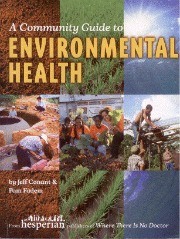
The Conservation, Food, and Health Foundation’s support of Hesperian Health Guide’s A Community Guide to Environmental Health reminds us of how many ripples its grants can have.
Exploring the link between the environment and health
The decision of the Conservation, Food, and Health Foundation to support the publication of a new health guide was an easy one. The trustees were already familiar with Hesperian’s Where There Is No Doctor – arguably the most widely used community health education guide in the world.
Back in 1996, the global conversation about the link between environment and health was in its ascendency, yet there were no high quality training guides for community organizations wrestling with environmental health concerns.
Early signs of success – ripples in the making
The book project took off in more ways than Hesperian or the foundation ever expected.
From the beginning, the project engaged a new international network of practitioners that jumped at the opportunity to field test the book in their communities. The community organizations were tough critics of language, images, and omissions. The laborious testing of content and activities helped refine each chapter more than any seasoned editor could have. The peer learning also helped build the capacity of the participating organizations and their connections with each other.
Many of the chapters were so well received by international health organizations that they “hit the streets” before the book went into final printing. While Hesperian had embraced a participatory publishing process, this latest publication helped push its work to a new strategic direction.
Strengthening the story with new voices
The foundation officially closed its file on this project when the first edition was published, but it continues to learn about the long term evolution of the project and the complexity of a new “crowdsourcing” publishing model.
In June 2011 Hesperian released Guia Comunitaria Para la Salud Ambiental, the Spanish-language edition of A Community Guide to Environmental Health. While translating and adapting the book, it worked with over 50 partner organizations in Latin America and the US, representing a wide variety of perspectives and experience with environmental health struggles.
One of the challenges of translation is to make sure the Spanish reflects the diversity of regional vocabulary throughout the Americas, while maintaining the simple, accessible style characteristic of Hesperian’s books. The Spanish edition also reflects the legal and political landscape of Latin America, including expanded information about recent UN declarations on the right to water and rights of indigenous peoples.
Finding new users, new networks, and new media to spread the word
A few ways in which Guia Comunitaria Para la Salud Ambiental is currently being used:
• to train health promoters in Latin America by the University of British Colombia Global Health Research Program;
• to educate farmers and community members on the harmful effects of pesticides, to encourage better agricultural practices, and to improve waste management in Antioquia, Colombia;
• to educate people through excerpts in a community newspaper in Intag, Ecuador.
In addition to Spanish, A Community Guide to Environmental Health has been translated and adapted into an ever-growing list of other languages, including Pashto, Indonesian and Mongolian.
“This book galvanizes us to act as individuals and, united and organized, to care for our health and to protect and improve the world that shelters us.” – Mirta Roses Periago, Director, Panamerican Health Organization
Embracing complexity and adopting a longer view
The foundation’s experience with the Hesperian project was not unusual. Few of the projects supported by the Conservation, Food, and Health Foundation’s grants fit into a tidy logic model or can be captured in a report at the end of a grant period. We have learned that the most important outcomes of a grant are often the ones that are the least unexpected.
Project Name: A Community Guide to Environmental Health
Grantee: Hesperian Health Guides
Project Location: International
Grantmaker: Conservation, Food, and Health Foundation
For More Information Contact:
Prentice Zinn c/o GMA Foundations 617-391-3091
Sarah Shannon, Executive Director, Hesperian Health Guides 510-845-1447


