Help Nonprofits stay Nimble: Know the 9 forces of change
BY CHALETTA HUERTAS
As experienced grantmakers, we know that nonprofit leaders operate effective programs by continuing to adjust and adapt to changing times while staying true to their mission. By understanding where the pressure to change comes from, funders can help nonprofits stay nimble, focused and operationally strong.
Seven leaders of Boston-area nonprofits joined us at GMA Foundations for lunch last month to talk about how to manage programs that stay rooted in an organization’s mission. Our guests shared stories of well-informed strategy and unforeseen hurdles. They all spoke of the frequent need to fine-tune their operations in response to a variety of pressures. To stay true to their mission, these leaders meet these forces with light-footed, self-assured, responsive management – management that looks more like a dance than a walk.
Forces affecting program operations
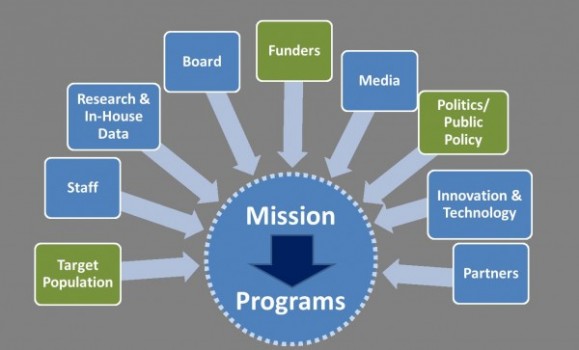 An organization’s mission tends to stay constant, but over time at least nine forces drive the need for program modifications.
Universally, these nonprofit leaders spoke of the changing needs of their own target populations and of the policy decisions of elected leaders as forces affecting the shape of their programs. They also spoke of funders as mostly positive influences on program adjustments. The anecdotes, both good and bad, demonstrated how open, honest communication can give funders a vital role in maximizing a program’s impact.
By identifying and understanding the pressures on their grantees’ programming, funders are better positioned to support effective operations.
Under Pressure: Nonprofit leaders speak of the need to change
These three examples (shown in green above) of nonprofit leaders responding to the forces around them may shed light on other situations you may have faced (or will face) as a funder.
The force of politics and public policy
The executive director of Thrive in Five—a public/private partnership to increase school readiness—described how her programs focused both on young children ages 0-3 and ages 3-5. The recent election of a new mayor led the organization to focus more on children ages 3-5 given the mayor’s campaign promise to provide universal access to pre-Kindergarten. This change in the political landscape occurred at the same time as a major funder for its work with younger children switched gears. Informed by new public policy and shifting funder priorities, the executive director is adapting the organization’s operations to meet the changing environment without losing sight of its mission.
Force from changes in their target population
Citing a “confluence of violence, poverty, homelessness and hopelessness,” the Executive Director describes how Transition House evolved from its founding in 1975 as an emergency shelter for women and children escaping domestic violence to a “full circle of care and support for adults and children…providing the tools people need to build safe and healthy lives.”
Combined with societal shifts in violence and poverty, the growing immigrant population has presented new challenges to established operations, requiring significant staffing changes. Additionally, recent changes in federal housing policy have led the organization to build coalitions with other service providers to get their story heard on a national level.
Funders as a force
The President of Cristo Rey Boston High School, a college preparatory Catholic high school for low-income students, describes a partnership with two nearby high schools, one public and one charter. Created at the request of a funder, the partnership brings teachers together to exchange ideas and work collaboratively. Though not easy or error-free, the effort has led to improved practices at his school.
Ideally, our guests agreed, funders become colleagues in strategic thinking and flexible management. But being a good sounding board is not enough. The strongest of these relationships were supported with monetary contributions for joint data collection, business planning, financial analysis and memberships in affinity groups.
Staying focused and flexible
A mission statement alone is like prayer without action. But a strong organizational focus on mission combined with flexible, responsive program operations keeps a nonprofit on track to succeed. We see that nonprofit leadership is complex. By understanding the nine forces organizations need to deal with, funders are better able to help them remain both true to their mission and adaptive to changing circumstances.
—
Chaletta Huertas is an associate consultant at GMA Foundations. Her expertise is in developing and maintaining collaborative partnerships of stakeholders, and researching, analyzing and evaluating programs. Her grantmaking interests include early childhood education, out-of-school-time programs, mentoring at-risk and high-risk youth, and faith-based initiatives. Contact: chuertas@gmafoundations.com


