A Bold Campaign Brings Clean Water to Haiti
SUCCESS STORIES
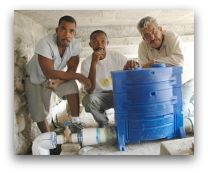 International Action’s Campaign for Clean Water is applying a low-tech, high impact strategy to bring clean drinking water to three million Haitians.
Such a bold goal was enough attract the attention of the Conservation, Food, and Health Foundation.
The Foundation made a grant for the campaign to bring clean water to 600,000 residents in and around the capital of Port-au-Prince.
Haiti has the highest rates of infant and child mortality in the Western Hemisphere. Waterborne diseases such as cholera, typhoid, hepatitis, and chronic diarrhea, are the key culprit.
International Action is installing the first practical system for protecting urban water supplies in very poor countries.
The program includes chlorinating water, providing medications to combat intestinal parasites, and organizing resident-led water boards that manage the water system.
A Low Tech Solution to a Chronic Problem
Since 2006 International Action has installed 110 neighborhood water tank chlorinators in some of Port-au-Prince’s poorest neighborhoods. The tablet chlorinators do not need electricity – they operate on the gravity flow from the tanks. The system is simple to install, easy to operate, and trouble-free to maintain.
Low cost interventions that can serve thousands are the benchmark of effective public health campaigns. In the community of Jalousie, chlorine for the chlorinators costs less than $50 a month and provides 50,000 residents with clean water. The approach works well with Port-au-Prince’s country-to-city migration pattern, which has resulted in a series of unplanned, essentially rural villages around the city center, each with its own wells and semi-independent water system.
A Neighborhood Approach Delivers Quick Results
Providing appropriate technology is only part of the challenge of providing and maintaining clean water systems in developing countries. International Action’s all-Haitian chlorinator installation team also builds local ownership of the systems by teaching residents how to monitor chlorine levels and make repairs. It also uses the installation of the new systems to educate residents about clean water.
Rosenline Elysee, a nurse at the Health Center Trou-Sable quickly noticed the change brought by clean water. “Prior to the chlorinator installation, patients came in for diarrhea, intestinal parasites, vomiting and stomachaches. Now we have fewer of these cases because we are using clean water.”
International Action has also helped develop a network of 40 neighborhood-based Water Boards to manage and maintain the water stations. The boards also distribute the de-worming medication Albendazole. The campaign to eliminate debilitating and life-threatening intestinal worms will reach 500,000 people by the end of 2009.
Cesare Cecile, a Haitian parent says, “I have three children. Their health was abnormal-they were bloated. Their bodies were frail-they could not get up in the morning. After taking the Albendazole pills their health was restored.”
A Public Health Victory
The U.S. Centers for Disease Control, the Inter-American Bank, World Bank, and UN Development Fund have sent representatives to learn how they might replicate the effort in other countries.
Organizations such as Engineers Without Borders, CARE, Partners in Health, as well as churches and medical groups are also signing on to help install chlorinators and support the campaign.
“It is a big positive change for our community. It is the water that we drink. Thank You.” said Joseph Ralph of the Delmas Water Board.
Project Name: Campaign for Clean Water
Grantee: International Action
Project Location: Haiti
Grantmaker: Conservation, Food and Health Foundation
For More Information Contact:
Prentice Zinn, Conservation, Food and Health Foundation, c/o GMA Foundations, (617)-391-3091
Lindsay Mattison, USA Executive Director, International Action (202)-488-0736
Dalebrun Esther, Port-au-Prince Haiti Executive Director, International Action


